Sampdoria find themselves at mid-table this season, having a better season and a comfortable place comparing to last season thanks to Marco Giampaolo. The Blucerchiati with Giampaolo has a clear game model as he insisted that every coach must have, Samp is a well-organized and a balanced team, but it is hard to consider Sampdoria as a possession-based team but the way they attack is impressive, although the results do not reflect their high performance.
'I began to study thanks to Sonzogni'
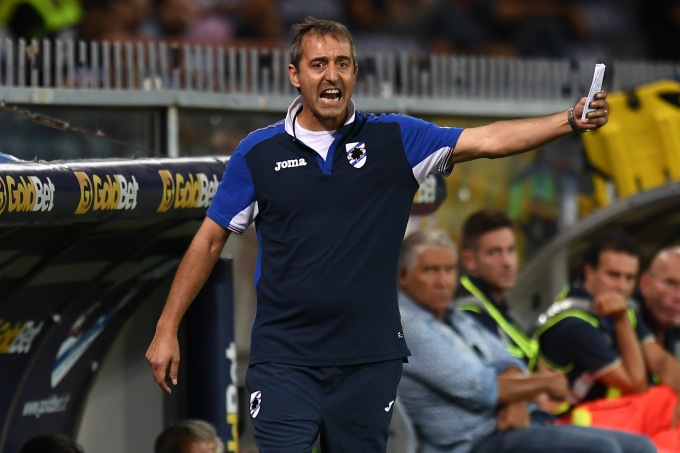
Giampaolo realized that he could be a coach at young age, growing up as a player with unknown coach called Giuliano Sonzogni Marco's coach at Siracusa, Andria, and Gualda, 'He was able to convey his ideas .. I listened to him and I understood, I even stopped playing right away just to be a coach'. 'I began to write in a diary, then computers came along and I created an electronic archive'. The Swiss-born has begun his coaching career with Pescara as a scout with Giovanni Galeone staff, a coach he also considers as a teacher. From Sacchi's school of the defensive organization in Sonzogni to the offensive game of Galeone, Giampaolo also has a touch of Zeman's high-tempo game, attacking patterns and movements in Delio Rossi as he assisted him at Pescara.

The first adventure for Giampaolo was when he appointed as an assistant coach to Massimo Silva at Ascoli in 2004, in fact, Giampaolo was the actual coach, the reason behind this is that he doesn't possess a license at that time. In his first season Ascoli promoted to Serie A, the following season they secured a 10th place away from relegation zone. The 39-year-old left Ascoli to join Cagliari, sacked twice and refused Cellino third call because 'pride and dignity are priceless'.

Siena's Giampaolo was remarkable not for what they achieved but the style he implemented, the way they played, how they were organized similarly to his Empoli and now Sampdoria, this could be a clue that his work at Empoli was not only a legacy of Sarri, what he has done at Siena attracted interest from Juventus, the Bbianconeri changed their mind and hired Ciro Ferrara. However, three months later he was sacked from the Tuscan club.
After short spells at Catania, Cesena in Serie A, the Inter fan signed with Brescia in Serie B, it was also a short one ended where he disappeared for three days and resigned after his side lost to Crotone at home, the coach who was one step away from Juve's bench ended up in Serie C side Cremonese in 2014, but thanks to Sarri he returned to Serie A after four years.

Both share the obsession of details, the organization, and above all the game idea, 'Sarri left a huge cult of work, principles of game that are based more on the ball than the man, the same ideas as mine as if I'd already trained them'. Sarri suggestion to Corsi to be replaced by Giampaolo was a great chance to be back to a level he belongs to, it is shame to see a man called 'un maestro' by Arrigo Sacchi coaching in lower divisions again. 'in January 2015 Sarri called me, I was in Cremona, and he said: "if I leave I'll suggest your name" .. we have known each other for years, he came to see me several times'.
ROMBO!

The Genoa-based team is an attacking side but somewhat more direct even if they are 6th of ball possession in Serie A so far, Giampaolo does not find splitting center backs or advanced full backs a necessity, the whole team keep short distance in five horizontal lines. Obviously, the stability of the backline is to avoid getting caught in negative transition, but this doesn't affect their way to keep the ball and progress attacks. Giampaolo describes his calcio and the 4-3-1-2 system as he is trying to develop the game through a series of triangles, which allows his teams to focus more in attacking depth, and to find defensive balance in the case of the loss of possession".
Use of full backs in the build-up

During the ball circulation the whole team advance (travel) together mainly to push the opponent into their own half, and on the other hand to find passing options centrally, with three ball-oriented midfielders moving towards the center backs to receive and to progress the ball.
Defensive Transition
Defensive Organization
On Zonal Marking 'It is a long process, it should be organized, we start immediately in pre-season.'
"When out of possession: we have to keep an eye on the ball position, and then the orientation, and also the teammates must always maintain the correct distance between each other."

An advantage that 4-3-1-2 has is it gives natural orientation in higher areas, in which there is no necessity to change the form when the team press the opponent's build up, players tasked to occupy their positions and move collectively according to the ball.
Sampdoria are aggressive and well-coordinated in pressing, they focus on controlling central areas and not to be penetrated through, 4-3-1-2 is the basic shape with situational variants 4-3-3/4-1-3-2 in higher areas. They press high trying to win the ball closer to the opponent's goal, or force them wide, and also to force the opponent to play long passes.
Attacking Transition
Generally, Giampaolo's game is very fluid during all four phases, they attack with persistence and pace through opponent's defensive shape, they don't struggle in negative transition thanks to their structure, while defensively they press intensively, they tighten the space and limit the opponent options, and when they win the ball, Samp's central focused shape allow them more passing options with fast combinations in short spaces and finding the third man.
Siena's Giampaolo
Conclusion
Danger is always around coaches in Serie A with away game against Napoli's Sarri, this could put Marco Giampaolo under pressure even if he's doing great, and his Sampdoria never give up until the final whistle, but unfortunately no one listen to Zeman when he says 'il risultato è casuale, la prestazione no'.
تعليقات
إرسال تعليق